
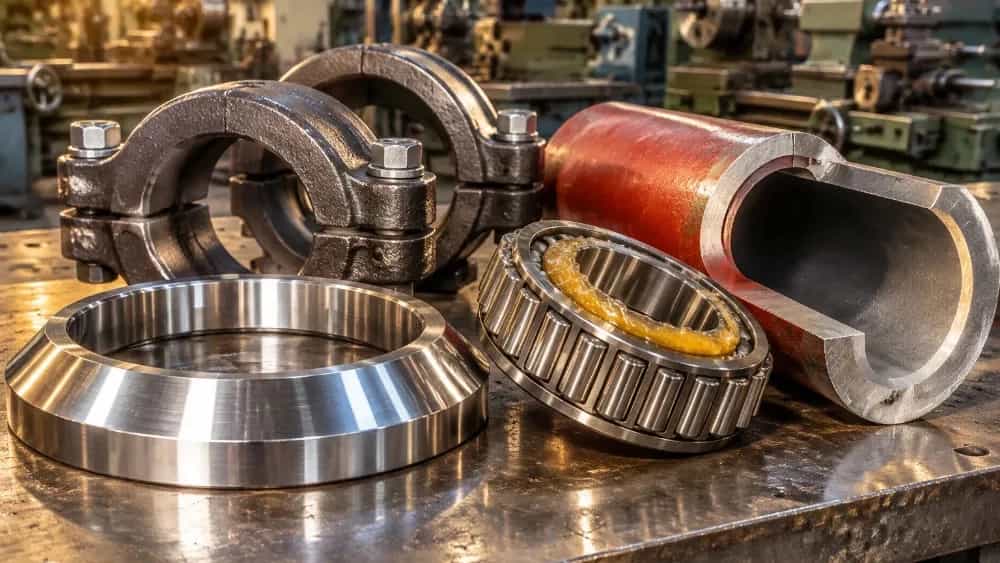
The price of accessories and spare parts of the mast pump and concrete mixer is determined based on three factors: the type of alloy (manganese or anti-stress chromite), the mother brand of the hydraulic system (Potzemeister, Schuying or Zumline) and exchange rate fluctuations. In the current market, the price range of consumable parts such as seats and rims ranges from 2 to 18 million tomans, and basic items such as concrete transfer cylinders and hydraulic pumps range from 70 to more than 350 million tomans. Choosing the part with the real thickness of the metal meat and standard thermal processing, the cost of stopping the concrete pouring and the sudden depreciation of the truck mixers is restrained by more than 40%.
When concrete with sharp aggregates and different cement grades passes through the pump throat at a working pressure of over 200 bar, the smallest defect in the used alloy will quickly cause the pipes to be punctured or the roller mixer to burn. Batching plant managers, truck mixer fleet owners, and construction contractors are always faced with a technical dilemma: use heat-treated forgings or inexpensive cast iron alternatives. Operational experience has shown that the pressure drop in the middle of the foundation concreting operation causes far greater damage than the initial price difference of first-class parts.
Factors influencing the price fluctuation of concrete transfer pump spare parts
The major difference in the official purchase invoices is due to the casting process and the metallurgy of the parts. Contrary to the similar appearance of the mast pump parts, the quality of the steel grade used plays the first role in determining the final price.
The effect of manganese and tungsten carbide alloys on seat and ring life
Seat and ring (glasses and cutting plate) are the main point of erosion in Saturi and Svalve pumps. The rims produced with tungsten carbide or chromite hardening coatings show a resistance up to three times that of ordinary cast iron samples. According to our technical investigations in high grade concreting projects, the use of low-quality rims due to rapid laxity leads to the leakage of concrete juice into the water tank and finally the destruction of the mother pump packings. This material difference is the main reason for the price gap between various brands and standard workshop custom parts.
Cost comparison of single-walled and double-walled pump rig pipes
The rig pump pipes are constantly exposed to hydrodynamic wear. Twin Wall pipes have an anti-wear inner layer with a hardness of more than 60 Rockwell C, and their base price is about twice that of ordinary seamed pipes. However, in high-rise projects that involve heavy crane downtime and dried concrete in the pipe, double-walled pipes, with the resilience of pumping more than 40,000 cubic meters of concrete, greatly reduce the final cost of each cubic meter.
The effect of originality of packings and hydraulic parts on the price of the system
Hydraulic components such as mother pump, solenoid valve blocks and concrete transfer pistons require the highest machining accuracy. Non-standard parts with small dimensional tolerance will leak hydraulic oil and increase circuit temperature. The cost of original polyurethane packings and German or Italian seals is higher, but it prevents the clutching of the mother pump and the imposition of several hundred million costs on the hydraulic unit.
Technical price guide for consumables and concrete mixer parts
In the section of track mixers, the mechanical pressure is concentrated on the boiler suspension system, the reduction gear and the resistance of the internal blades. Any swaying of the chassis or wear of the rollers will result in a loss of power of the driving motor.
Roller, shaft and roller mixer base
The rollers bear the gross weight of the concrete pot, which sometimes reaches more than 30 tons when full. Rollers that are made of CK45 or MO40 steel forging material have a higher price than cast iron samples, but they do not suffer from surface cracking due to continuous stress. Integrated turning, precise tolerance of conical bearings and dust-proof double felt bowls are some of the parameters that justify the final price of a high-quality roller.
Digest gearbox and pump and mixer hydro motor
Boiler drive system, including hydraulic pump and hydromotor (mainly Eaton or Sauer Danfoss systems) works with PMP, ZDF or Patrolin solar gearboxes. The price of this collection is subject to changes in the currency market because it is imported. However, the health of the sun gears and maintaining the standard tooth spacing is critical, as the corrosion of a side gear can completely disintegrate the gearbox shell.
Anti-wear sheets of internal blades and boiler body
Concrete guiding blades inside the pot are exposed to strong friction of silica particles. The use of Hardox or ST52 anti-wear sheets, the industry standard, to make the spiral blades, increases the total price of making the boiler, but it increases the useful life of the boiler up to twice as compared to the normal waste sheets, and it prevents the concrete from muddling or the sediments sticking to the bottom of the boiler.
Analysis of the difference between aftermarket, European stock and new parts in the market
In the Iranian market, the categories of parts include new originals, domestically produced samples with reverse engineering, and rebuilt stock parts. Remanufactured hydraulic parts are an economical option for projects with a limited budget if they have been pressed by a specialized test team; However, in the case of parts such as concrete pistons, impact tires and pipe gaskets, the use of used parts is not economically justified due to the high risk of pressure discharge and loss of life.
How to maintain to reduce cost and delay the depreciation of parts
Daily service of washing the pipeline path with a sponge ball, continuous greasing of the mixer rollers during heavy shifts, and control of the clarity and viscosity level of the hydraulic oil are the simplest measures that postpone the need for early replacement of expensive parts. Accurately adjusting the distance between the rim and the seat after every 5,000 cubic meters of operation improves the useful life of this sensitive part by 30%.